


Mom, Dad, Why Don’t I Feel Okay?
Understanding, preventing, and addressing emotional
and psychological difficulties in children and adolescents
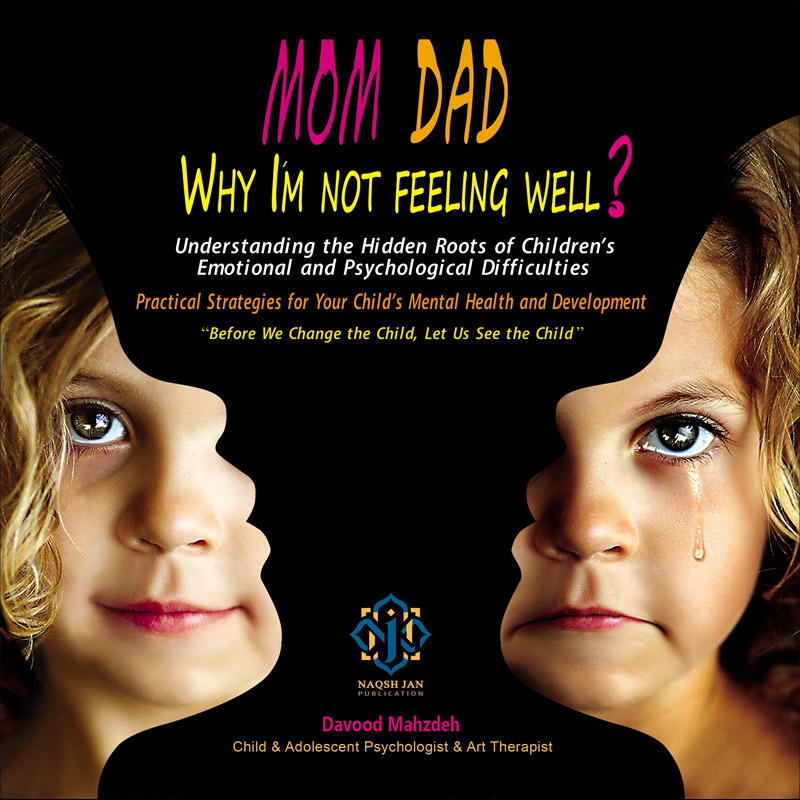
Book Details
Author: Davood Mahzadeh
Publisher: Naqsh Jan Publications
First Published: Mohajer Publishing, 1401 (2022–2023)
Page Count: 289 pages
Trim Size: Square Format
Cover Type: Paperback
Features: Illustrated, full-color edition
ISBN: 978-635-96318-3-6
About the Book
Mom, Dad, Why Don’t I Feel Good?, by Davood Mahzadeh, explores the roots of emotional and psychological difficulties in children and adolescents and offers a more mindful approach for parents responding to these challenges. The book begins with a fundamental question: Before trying to stop, correct, or change a child’s behavior, have we truly seen and understood the child, their developmental needs, and the relationships in which they live?
The author emphasizes that a child’s behavior is information, not identity. A single behavior cannot reveal the whole of a child’s inner world. Children’s development is shaped by a range of factors, including family life, early experiences, the environment, school, friends, culture, and the social and digital worlds around them. From this perspective, meaningful change may require attention not only to the child’s behavior, but also to parental responses and the quality of the relationships surrounding the child.
The book is organized into two parts:
Part One explores the contexts and underlying factors that contribute to difficulties in childhood and adolescence. Topics include early developmental environments, parent–child relationships, the formation of identity and self-esteem, separation and divorce, grief and loss, school, sexual development, media and the digital world, and difficult feelings and thoughts.
Part Two moves from understanding and awareness toward practical action and mindful parenting. Its topics include parental self-awareness, understanding and accepting the child, the art of listening, helping children recognize and express their feelings, play and participation, balanced attention, rewards and consequences, teaching boundaries, family dialogue, the use of art, self-acceptance, and recognizing when professional support may be needed.
One of the book’s central themes is parenting as a dynamic process—one in which observation, understanding, choice, change, and reflection take the place of rushed reactions and responses focused solely on behavior. The author also distinguishes between accepting a child and accepting every behavior the child displays. Acceptance means seeing and understanding the child more clearly; it does not mean abandoning boundaries or responsibilities.
This book is intended for parents and caregivers, psychologists, counselors, psychotherapists, social workers, teachers, and educators, as well as students in psychology, counseling, education, and child development.

Leave a Reply